

House Democrat seeks third term representing Beacon
When Pat Ryan entered Congress in August 2022, in a special election to fill a vacant seat, he eked out a victory, winning by 3,837 votes of 132,246 cast, or 2.9 percentage points, over former Dutchess County Executive Marc Molinaro. In the general election later that year, the Democrat defeated Republican Colin Schmitt by an even smaller margin, 1.3 percent.
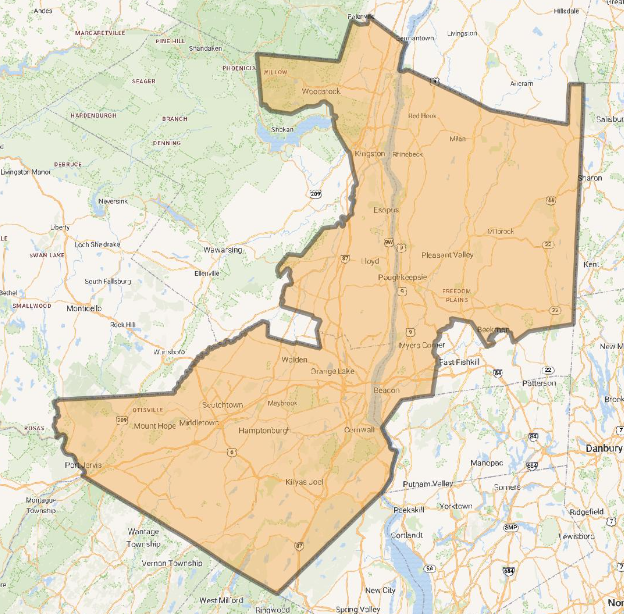
Two years later, it wasn’t close: Ryan defeated Alison Esposito by 14 points, turning what had been seen as a “purple” seat into one solidly blue. The district includes Orange County and parts of Ulster and Dutchess, including Beacon.
That has set a high bar for his 29-year-old Republican challenger on Nov. 3, Jackie Auringer, a Kingston native who has never held elected office.
Ryan has the advantages of incumbency, widespread name recognition and a formidable fundraising operation, said Richard Born, a Vassar College political science professor who has studied congressional elections and redistricting for decades. As of Sept. 30, Auringer had raised $153,000 during the election cycle, compared to Ryan’s $5.3 million.
Ryan also has the national political winds in his sails in a midterm cycle widely viewed as unfavorable for Republicans amid high gas prices, rising inflation and low approval ratings for President Donald Trump.
Born says that, taken together, that makes Auringer’s candidacy a long shot, predicting that if she defeats Ryan, it would be “the biggest upset in the whole country.”

In the district, noting that he has seen little advertising and scant evidence of canvassing by either side. “It’s not a very active campaign,” Minkoff said.
No recent independent public polling of the race has been released. Born said that while the district has become somewhat more Democratic in recent years, he still considers it a swing district. As of February, 38 percent of registered voters were Democrats, 27 percent were Republicans, and 29 percent were unaffiliated, according to the state Board of Elections.
In 2024, Democratic presidential candidate Kamala Harris carried the district by 3 percentage points. But in that same election, Ryan won by 14 points. Born attributes this to Ryan developing what political scientists call a “personal vote,” or support from voters based on their view of the candidate himself rather than simply his party.
Born said Ryan has cultivated that support, in part, by working on local issues and being accessible to constituents. In a September interview, he positioned himself as a moderate Democrat willing to work across party lines, an approach Born said suits a district where neither party enjoys an overwhelming advantage.
“The district is moderate, and Ryan is a relatively moderate Democrat,” Born said, noting that Ryan is “open to the idea of working with Republicans.” But maintaining that reputation will be important, Born said. “He has to still come across as being relatively bipartisan.” At the same time, Minkoff said, Ryan must keep progressive voters motivated enough to turn out.
Auringer has structured her campaign around challenging Ryan’s strengths, seeking to turn his incumbency against him and undermine the moderate, locally rooted image he has cultivated. She has portrayed him as a Washington insider who has lost touch with the district and is shifting increasingly to the left. In September, she filed an ethics complaint questioning whether Ryan still lives in the Hudson Valley. She has also attacked his ties to wealthy political donors and groups, including the pro-Israel lobbying group AIPAC.
Ryan’s campaign, meanwhile, has sought to capitalize on dissatisfaction with the Trump administration by tying Auringer closely to the president and his political movement. His campaign has called Auringer a “full-blown MAGA influencer straight out of Mar-a-Lago.”
“The Trump administration is doing devastating harm to our community, so we need someone to be fighting back against those harms,” Ryan said.
In keeping with the moderate approach he has cultivated, Ryan said his job is both to “fight back against the harm and work constructively to move good things forward. I think we need both right now.”
Both candidates have centered their campaigns on the same overriding concern: affordability. “Priority one, two and three are lowering costs,” Ryan said.
Who is Jackie Auringer?
Auringer, who has a marketing degree from Florida Gulf Coast University, works for her family’s Kingston-based construction company, Urban Precast.
Neither Auringer nor her campaign spokesman, Dave Catalfamo, responded to seven emails requesting an interview over more than four months. In a debate organized by the Daily Freeman on Oct. 16 over Zoom, she read an opening statement that blasted Ryan and the Kingston newspaper before signing off. Ryan then answered questions for about an hour.
The candidates also debated on Thursday (Oct. 22) at Mount Saint Mary College in Newburgh (video below).
Auringer, as outlined on her website and in campaign materials, has argued that rising housing, energy and other costs make it increasingly difficult for working families to remain in the Hudson Valley.
She has called for lowering taxes, cutting government spending and reducing regulations that she says drive up housing and business costs. She has also emphasized expanding opportunities for skilled tradespeople and supporting small businesses.

Auringer has pointed to her experience working in her family’s business as preparation for Congress, saying it has given her firsthand knowledge of how rising fuel, insurance, materials and payroll costs affect local employers.
“In construction, the work either holds or it doesn’t,” she wrote in a May statement explaining her candidacy. “Washington has forgotten that.”
Ryan’s record
Ryan, 44, also grew up in Kingston. He graduated from West Point, then served two combat tours in Iraq, earning two Bronze Stars. After several years in the technology sector, he made an unsuccessful bid for the Democratic line in the 2018 House race before winning a 2019 special election to become Ulster County executive.
Ryan is running on his record, arguing that the legislation and federal funding he has pursued in Congress demonstrate both a commitment to lowering costs and an understanding of the district’s needs.
He highlighted his support for the 21st Century ROAD to Housing Act, a bipartisan bill that became law in July and aims to increase the supply of affordable housing.
Ryan acknowledged the challenges of building new housing in the Hudson Valley, including opposition from residents concerned about development and preserving the region’s rural character. But he argued that increasing the housing supply must be a priority.
Ryan said much of his local work has focused on securing federal funding for infrastructure projects, and he regularly speaks with local officials about where federal assistance could help.
Ryan has also advocated for environmental protections, farmers and immigrants facing deportation. His Hudson River Protection Act, signed into law in December 2025, prohibits new barge anchorages along the Hudson River. This spring, he joined other elected officials in pressing the federal government to provide disaster assistance to Hudson Valley farmers whose crops were damaged by an April freeze, an effort that resulted in a federal disaster designation in July. He has also advocated for immigrants detained by federal authorities, including Bard College student Ali Sajad Faqirzada, who was released from custody in April.
Although much of Ryan’s cost-cutting legislative agenda has stalled in the Republican-controlled House, he introduced a bill directing the federal government to study the factors driving up grocery prices. He has also backed legislation that would limit utility company profits. On housing, Ryan introduced legislation to help finance homes for middle-income workers.
A quiet but fiery campaign
The candidates have traded accusations over campaign contributions and where they “really” live, with each accusing the other of personal attacks.
Since her campaign launched in April, Auringer has delivered a steady stream of pointed attacks through press releases and social media. One Instagram post featured Ryan’s face superimposed onto a character from the 2004 movie Mean Girls. Another parodied the 2002 film Big Fat Liar, replacing “Fat” with “Pat,” a jab at Ryan’s claims about securing federal funding for local law enforcement.
Auringer’s campaign website features a running countdown titled “Pat’s Promise Clock,” tracking the time since Ryan allegedly pledged to return campaign contributions associated with AIPAC. Ryan’s campaign told the Washington Examiner that it had returned all contributions made directly by AIPAC’s political action committee.
In September, Auringer escalated one of her central lines of attack by filing an ethics complaint questioning whether Ryan lives in the Hudson Valley. Ryan says he has lived in Gardiner since being elected to Congress.
Ryan’s campaign, meanwhile, has sought to portray Auringer as a Florida outsider, claiming she spent the past five years living there and has ties to Trump’s political circle at Mar-a-Lago.
Auringer has also sought to turn Ryan’s growing profile beyond the district against him, suggesting that he is more interested in pursuing higher office, such as U.S. senator, than serving his constituents. Ryan dismissed that possibility in September when asked whether he was considering a statewide campaign in 2028.
“I love this job,” he said. “As long as people keep wanting me in it and trusting me, I want to keep working on it. I’ve got a lot more work to do.”


This article should note that Ryan announced months ago he was returning all money from AIPAC and no longer wanted their support.